I Wonder: The Significance of the Catholic Church in the Development of International Standards on Artificial Intelligence
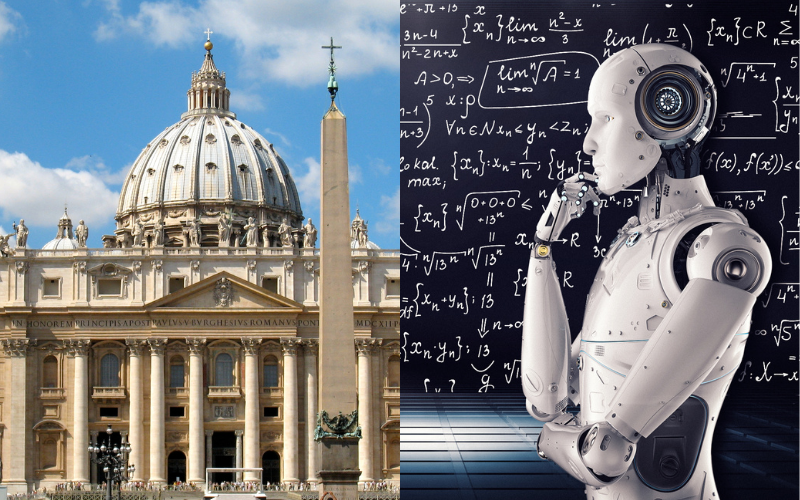
Vatican City is the world’s smallest independent nation-state, yet it hosts the leader of the world’s largest Christian denomination and second largest religion overall (approximately 1.4 billion followers). In light of this moral authority over such huge proportions of the world’s population, the Catholic Church has had a significant influence on many issues of international law such as the Law of Armed Conflict, as well as a host of social justice-related topics. Despite the decline of Church attendance in the West in recent decades, as the global Church continues to grow in numbers and influence, so too will their role in shaping how mankind navigates the Artificial Intelligence (AI) revolution. A basic understanding of how the Catholic faithful are guided to interact with AI can help legislators, developers, and businessmen better tailor products that are morally acceptable to this worldwide subset of the population.
At first glance, it may seem like the venn diagram between a 2,000 year old religious institution and the latest technological innovations in AI shows no overlap. However, both Pope Francis and Pope Leo XIV have spoken publicly on AI, even going so far as to claim that AI poses a “main challenge for humanity.” Why does the Church care so much about this issue? What qualities and trends of the booming AI industry pose a challenge to the practice of the Catholic faith?
In a 2024 speech to the G7, Pope Francis spoke at length on the many possible benefits and dangers of AI, while also acknowledging that AI was here to stay. Far from condemning it, Pope Francis recognized AI as the fruit of human creative potential, exciting the imagination in its potentially endless uses to alleviate hardships of the human condition. Although much has been said about its parallel dangers, above all else Pope Francis viewed AI as a tool saying, “the benefits or harm it will bring will depend on its use.” Six months later, the Vatican released formal guidelines for implementing AI in Vatican City, Linee Guida in Materia di Intelligenza Artificiale. As Dr Steven Umbrello, Managing Director at the Institute for Ethics and Emerging Technologies summarized, these guidelines center around four central principles that are designed to shape the development of AI in ways conducive to the Catholic view of human dignity. First, a given use of AI must be oriented towards serving humanity and promoting the dignity of the individual. Second, it must be subject to oversight, and its workings transparent to the public. Third, it must simultaneously avoid causing harm to the earth, as well as promote its well-being. Finally, it must promote the common good, and not perpetuate social inequalities. While these guidelines may be very general, industry leaders can be sure that this will not be the last time the Church weighs in on AI. Just as with other societal topics of concern to the Church, such as care for the poor or human sexuality, the Church will take these general principles and later develop more specific doctrine as AI becomes further integrated into our daily life.
The principles of Linee Guida in Materia di Intelligenza Artificiale will not result in a one-size-fits-all solution for local enforcement. The social inequalities and ideal of a “common good” that a well-meaning application of AI may attempt to address will not look the same in every community, especially those that differ significantly from the Catholic worldview. Similarly, the resources available to provide ethical oversight vary greatly by nation, state, community, etc. Nevertheless, the through-line of the Holy See’s teaching on AI is that its use must be to serve mankind, not the other way around.
Pope Leo XIV, Francis’ successor, has continued the Church’s involvement in AI, and has offered several human traits that he views as beyond the scope of what AI is properly suited for (or capable of doing in the same manner as human beings). First, AI can never judge between right and wrong. Therefore, in addition to the prohibition on using AI for legal judgments, the Church would also not allow AI to advise on moral or ethical dilemmas. In a video broadcast to a youth conference, Pope Leo XIV challenged the attendees to evaluate the impact on their lives if AI suddenly disappeared: Could they still think without it? Create without it? Most importantly, has using AI detracted from the ability to wonder or contemplate the beauty of creation?
It is this metric that is of concern for the world’s Catholics at this stage of the AI revolution. Insofar as AI is used to promote human flourishing and alleviate suffering, the Catholic Church seems willing to allow integration into the lives of the faithful. If, however, the use of AI subordinates the key distinctions of life that the Church views as uniquely human, industry leaders can expect pushback and opposition from a moral authority with worldwide influence.
Article Written by Alastair R. Burgess
Sources:
The Global Religious Landscape: A Report on the Size and Distribution of the World’s Major Religious Groups as of 2010, PEW RSCH. CTR., (Dec. 18, 2012), available at https://www.pewresearch.org/religion/2012/12/18/global-religious-landscape-exec/ (last visited Jan. 17, 2026).
James Gaffney, Just War: Catholicism’s Contribution to International Law, 14 LOGOS: A J. OF CATHOLIC THOUGHT AND CULTURE, 44 (2011) available at https://muse.jhu.edu/pub/82/article/444333/pdf (last visited Jan. 17, 2026).
Elizbaeth Heger Boyle, Shannon Golden & Wenjie Liao, The Catholic Church and International Law, 13 ANNU. REV. LAW & SOC. SCI. 395, 395-411 (2017), available at https://www.annualreviews.org/content/journals/10.1146/annurev-lawsocsci-110615-084534 (last visited Jan. 17, 2026).
Vatican News, New Church Statistics Reveal Growing Catholic Population, Fewer Pastoral Workers, VATICAN NEWS, (March 20, 2025), available at https://www.vaticannews.va/en/vatican-city/news/2025-03/pontifical-yearbook-2025-priests-religious-statistics.html (last visited Jan. 17, 2026).
Nicole Winfield, Pope Leo XIV Lays Out Vision for His Papacy and Identifies AL as a Main Challenge for Humanity, PBS NEWSHOUR NewsHour, (May 10, 2025), available at https://www.pbs.org/newshour/world/pope-leo-xiv-lays-out-vision-for-his-papacy-and-identifies-ai-as-a-main-challenge-for-humanity (last visited Jan. 17, 2026).
Pope Francis, Address of His Holiness Pope Francis at the G7 Session on Artificial Intelligence (June 14, 2024), available at https://www.vatican.va/content/francesco/en/speeches/2024/june/documents/20240614-g7-intelligenza-artificiale.html.
Pontifical Commission for the State of Vatican City, Decreto N. DCCII: Linee Guida in Materia di Intelligenza Artificiale (Dec. 16, 2024), available at https://www.vaticanstate.va/images/N.%20DCCII.pdf (last visited Jan. 17, 2026).
Steven Umbrello, Lessons from the Vatican’s AI Guidelines, WORD ON FIRE (Feb. 6, 2025), available at https://www.wordonfire.org/articles/lessons-from-the-vaticans-ai-guidelines/#:~:text=Human%20Dignity:%20AI%20must%20serve,not%20deepen%20existing%20social%20inequalities (last visited Jan. 17, 2026).
Steven Umbrello, Pope Leo XIV and the New Social Question of AI, WORD ON FIRE (May 20, 2025), available at https://www.wordonfire.org/articles/pope-leo-xiv-and-the-new-social-question-of-ai/ (last visited Jan. 17, 2026).
Pope Leo XIV, Message of the Holy Father to Participants in the Second Annual Conference on Artificial Intelligence, Ethics, and Corporate Governance (June 17, 2025), available at https://www.vatican.va/content/leo-xiv/en/messages/pont-messages/2025/documents/20250617-messaggio-ia.html (last visited Jan. 17, 2026).
Catholic News Service, Pope Leo’s Advice for Using AI and Smartphones (Nov. 21, 2025), YouTube video, available at https://www.youtube.com/watch?v=aXA4sF-ij78 (last visited Jan. 17, 2026).
Catechism of the Catholic Church § 362 (2d ed. 1997).
You May Also Like